

Firestone Did What
Governments Have
Not: Stopped Ebola
In Its Tracks
John W. Poole/NPR
John W. Poole/NPR
The classic slogan for Firestone tires was
"where the rubber meets the road."
When it comes to Ebola, the rubber met
the road at the Firestone rubber plantation
in Harbel, Liberia.
Harbel is a company town not far from the
capital city of Monrovia. It was named in
1926 after the founder of the Firestone Tire
and Rubber Company, Harvey and his wife,
Idabelle. Today, Firestone workers and their
families make up a community of 80,000
people across the plantation.
Firestone detected its first Ebola case on
March 30, when an employee's wife arrived
from northern Liberia. She'd been caring for
a disease-stricken woman and was herself
diagnosed with the disease. Since then
Firestone has done a remarkable job of
keeping the virus at bay. It built its own
treatment center and set up a
comprehensive response that's managed
to quickly stop transmission. Dr. Brendan
Flannery, the head of the U.S. Centers for
Disease Control and Prevention's team in
Liberia, has hailed Firestone's efforts as
resourceful, innovative and effective.
Currently the only Ebola cases on the
sprawling, 185-square-mile plantation
are in patients who come from
neighboring towns.
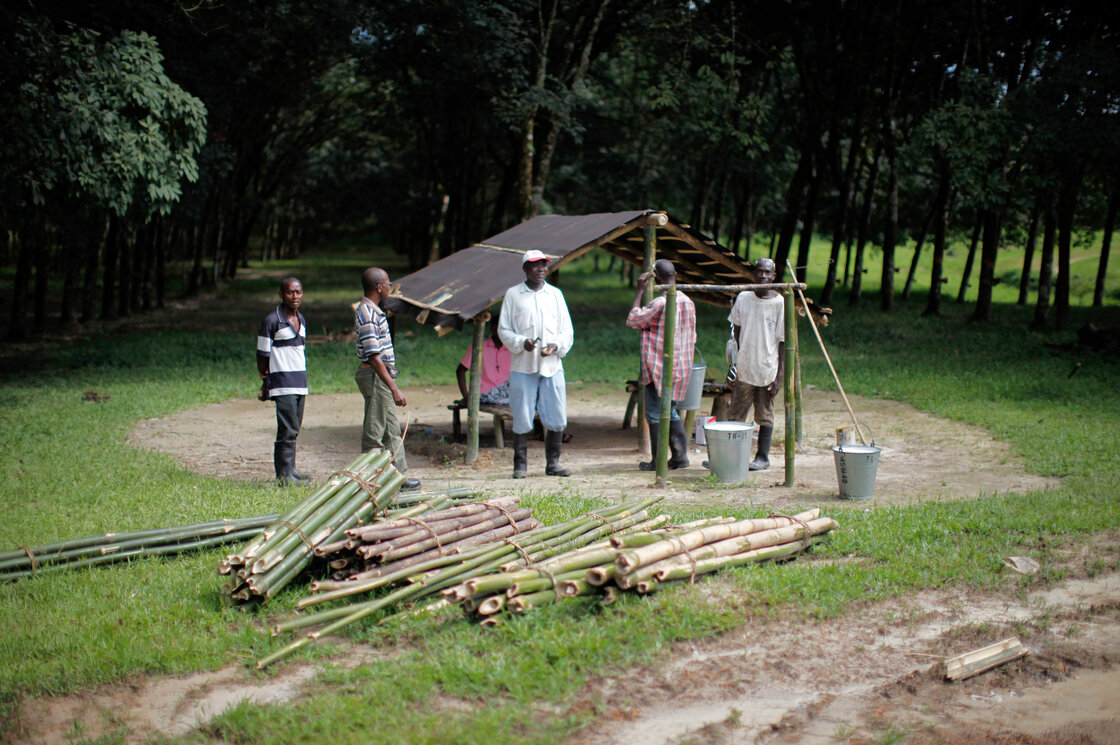
Long rows of dappled rubber trees cover
Harbel's landscape. Prevailing winds
cause the adult trees to lean westward.
Back when Firestone was still based in
Ohio, employees used to joke that the
trees are "bowing to Akron."
When the Ebola case was diagnosed,
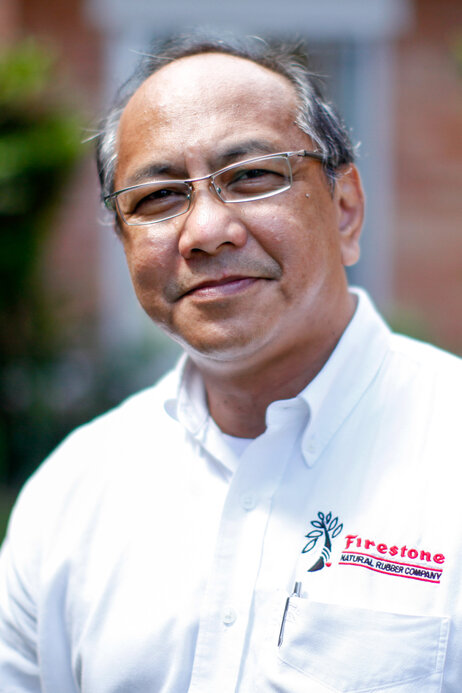
"we went in to crisis mode," recalls
Ed Garcia, the managing director of
Firestone Liberia. He redirected his
entire management structure toward
Ebola.
John W. Poole/NPR
Garcia's team first tried to find a hospital
in the capital to care for the woman.
"Unfortunately, at that time, there was
no facility that could accommodate her,"
he says. "So we quickly realized that we
had to handle the situation ourselves."
The case was detected on a Sunday.
Garcia and a medical team from the
company hospital spent Monday setting
up an Ebola ward. Tuesday the woman
was placed in isolation.
"None of us had any Ebola experience,"
he says. They scoured the Internet for
information about how to treat Ebola.
They cleared out a building on the
hospital grounds and set up an isolation
ward. They grabbed a bunch of hazmat
suits for dealing with chemical spills at
the rubber factory and gave them to the
hospital staff. The suits worked just as
well for Ebola cases.
Firestone immediately quarantined the
woman's family. Like so many Ebola
patients, she died soon after being
admitted to the ward. But no one else
at Firestone got infected: not her
family and not the workers who
transported, treated and cared for her.
The Firestone managers had the benefit
of backing and resources of a major
corporation — something the communities
around them did not.
Firestone didn't see another Ebola case
for four months. Then in August, as the
epidemic raced through the nearby capital,
patients with Ebola started appearing at
the one hospital and several clinics across
the giant rubber plantation. The hospital
isolation ward was expanded to 23 beds
and a prefab annex was built. Containing
Ebola became the number-one priority of
the company. Schools in the town, which
have been closed by government decree,
were transformed into quarantine centers.
Teachers were dispatched for door-to-door
outreach.
Hundreds of people with possible exposure
to the virus were placed under quarantine.
Seventy-two cases were reported. Forty-eight
were treated in the hospital and 18 survived.
By mid-September the company's Ebola
treatment unit was nearly full.
As of this weekend, however, only three
patients remained: a trio of boys age 4, 9 and 17.
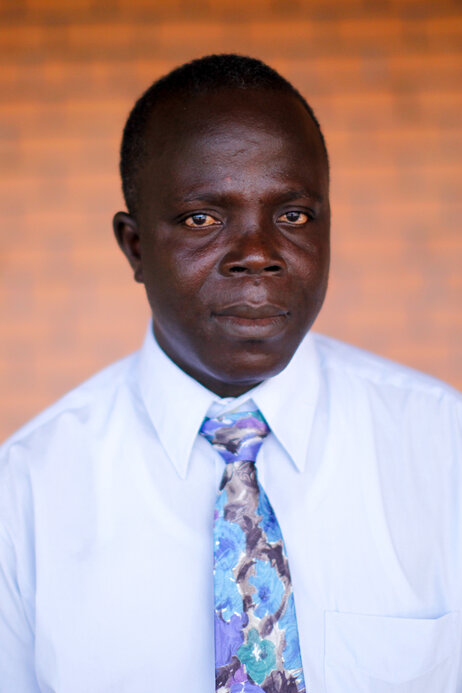
"So we have these three," says Dr. Benedict
Wollor, coordinator for the Ebola treatment
unit at Firestone. "We are concerned because
by this morning the 4-year-old was just crying."
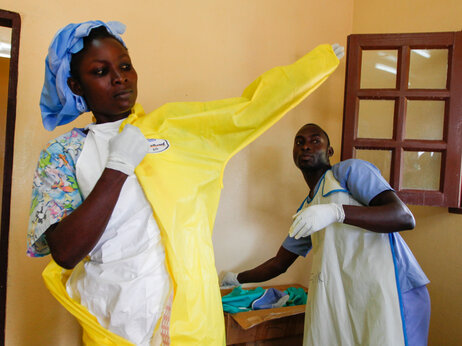
A team is getting dressed in full body suits,
gloves and goggles to enter the ward: a doctor,
two nurses and a man with an agricultural
sprayer full of disinfectant strapped to his back.
Wollor says the team has a lot of work to do
before they get overheated in their industrial
spacesuits.
John W. Poole/NPR
"They have to change Pampers, bedding,
even bathe them," says Wollor. "Make
sure they're clean. If someone is dehydrated,
open an IV line. Imagine how we maintain an
IV line on a kid."
These three boys all came from outside the
plantation. So even as the worst Ebola
outbreak ever recorded rages all around
them, Firestone appears to have blocked
the virus from spreading inside its territory.
Dr. Flannery of the CDC says a key reason
for Firestone's success is the close monitoring
of people who have potentially been exposed
to the virus — and the moving of anyone who
has had contact with an Ebola patient into
voluntary quarantine.
By most accounts, this Ebola outbreak
remains out of control, with health care
workers across West Africa struggling to
contain it.
Asked what's needed to turn that around,
Flannery says, "More Firestones" — places
that have the money, resources and
unwavering determination to stop Ebola.
Reported from Monrovia by JASON BEAUBIEN


No comments:
Post a Comment